Showing posts with label horses. Show all posts

Saturday, December 4, 2010

FREEDOM'S FAMILY STORY PART I: MOONBEAM SHINES, A FLEETING LEGACY

v       In the days, weeks, and months after the Calico roundup, I followed carefully two mares belonging to the iconic black stallion Freedom, seeing them at Broken Arrow every week until BLM closed the doors.
©1/2/10 by Craig Downer
Freedom making his escape, having just cleared a 6-foot fence
 and crashed through a 3-strand barbed wire fence...
                   ©5/2/10  Elyse Gardner  
Dahlia, Freedom's lovely, frightened three-year-old mare at Broken Arrow, four months 
(to the day)  following her capture.  
          We rescued them with the help of a precious sister wild horse lover and the stalwart Barbara Clarke, who took them in at DreamCatchers Sanctuary where they are living once again almost as wild horses.  I say "almost" because they don't live with stallions here.  There are stallions; Barbara doesn't geld, but the stallions live on several hundred acres fenced well away from the mares since DreamCatchers does not want to contribute more homeless mustangs into the mix.    
        Dahlia, Freedom's lovely young mare, lost everything, as the wild horses do, when she was rounded up. This is her introduction; I am working on the video and will tell you her story, as much as I know.  She had a foal; he was taken from her immediately.  
          I made a commitment to those mares that I would do all I could to see that they would never be separated or subjected to brutality, and thanks to these amazing women, that commitment is kept.  Well, nearly kept.  Dahlia is a particularly wild, frightened girl who clings to River, the older mare.  When first I met her, she could barely stand to be looked at from 25 feet away.  
              ©6/10/10 Elyse Gardner
It took us four months to find this timid soul among the 1,900-odd horses at Broken Arrow.  These girls were so spooked, they hid way in the back of the pens.  Here she is in her usual position -- taking refuge behind River. 


Dahlia and River, her surrogate mother.  I thought River was pregnant.  
BLM said no, she's just an older mare, and they look that way...
       One of Freedom's mares, River, had a bonus.  BLM thought she was just mature and round (she's 17, and according to them, "they just look like that sometimes after they've had numerous foals).  But alas, she surprised everyone, and right after we had safely adopted her -- she was bought and paid for but not yet picked up -- she gave birth to Freedom's little girl.  I was thrilled. I wasn't bargaining for another horse, but this little filly was royalty; what can I say? -- a legacy, a heritage, a precious family's story to tell, all the sweeter because it continued.  
      Meet Moonbeam, Freedom's daughter.
                    ©8/30/10 by Elyse Gardner
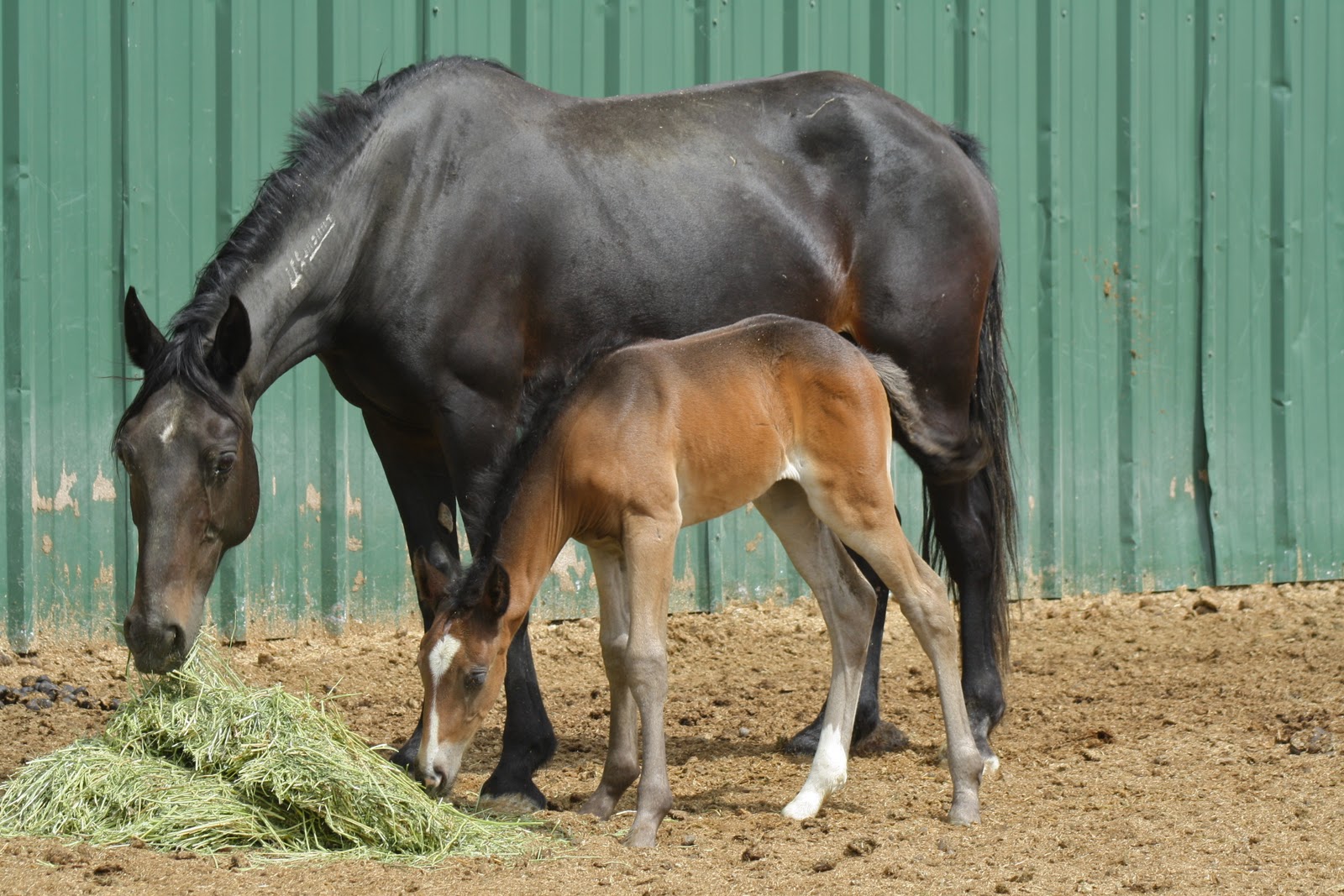
Freedom's little girl here is all of two weeks old, born at Palomino Valley around August 15.  BLM did not note the exact day of her birth, but it was right around 8/15.   
                      ©8/30/10 by Elyse Gardner
                      ©8/30/10 by Elyse Gardner

Arrival at DreamCatchers, Moonbeam is all of two weeks old. 
         I returned to see the Calico girls, as we call them, on September 24.  We had also adopted three other fillies from Calico.  They are quite the close-knit group, and all loved and protected little Moonbeam.  
          By November 4, when the photo below was taken, Moonbeam had turned completely black except for her blindingly white moonbeam sock on her right rear, and her star and snip.   
                  ©11/4/10 Elyse Gardner
 Left to right:  Dahlia, Gemini, Ladybug, Moonbeam (turned all black!), River, Gypsy.
 Gypsy, the alpha mare from the Warm Springs area, looks like she is with foal. 
       ©9/24/10 Elyse Gardner
      The Process of Turning Black:  Stepping back a few weeks to 9/24, what is happening to this baby?  Oh my; she's turning black like her famous daddy.  Full of black paint splotches...  
                   ©9/24/10 Elyse Gardner
                     ©9/24/10 Elyse Gardner   Sleepy Moonbeam turning black....
     Here is a brief sort of chronicle of this little one.  It's amazing to watch her transformation to becoming her father's and mother's daughter in looks as well as fact.  I'm loving the medium of video more and more...
For Moonbeam...
           On Sunday, November 21, 2010, a mountain lion killed a foal at DreamCatchers.  There is no easy way to say this, no easy way to hear it.  The foal was Moonbeam.  My heart is broken, and my knee injury makes me vulnerable, and it hurts all over.  But she got to live without pens.  My Calico girls were taking shelter up in the trees and boulders from the inclement weather, and being a very patient predator, the lionness waited for her opportunity.
            Barbara has moved the horses, and we will seek to raise funds to put up anti-predator fencing, which involves including some hot (electric) lines within the fence structure.
            River called for her baby for three days.  She was there; she knew what happened, but she continued to call in hopes...  
            The girls have settled down.  Gypsy is probably carrying a foal.  She would have conceived just before being rounded up in early January.
                       ©9/24/10 Elyse Gardner  
Gypsy... She's definitely our alpha girl.
                         ©9/24/10 Elyse Gardner  
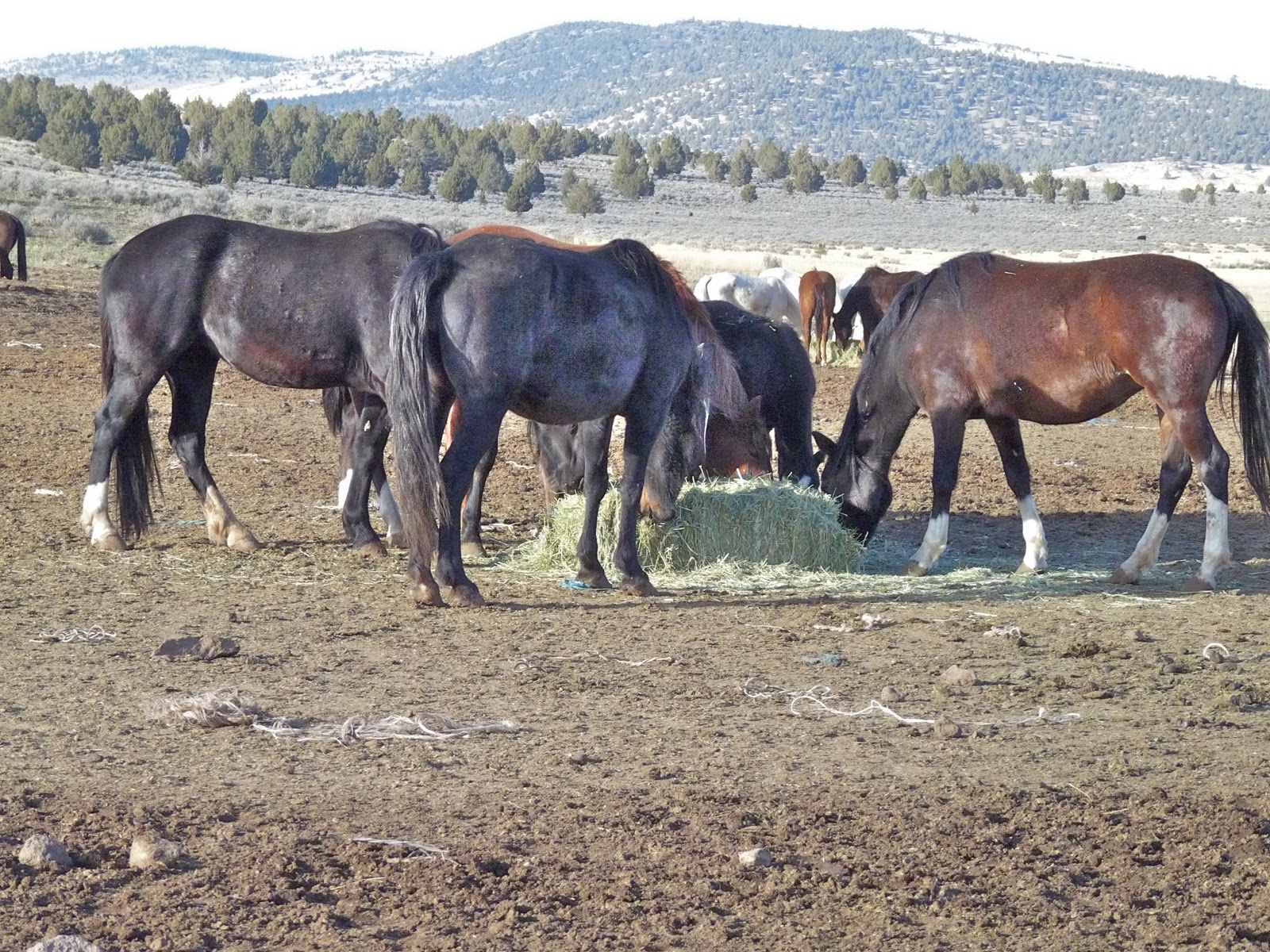
              Gypsy had irritated eyes and allowed me to slip a fly mask 
on her, very calmly, her second day here.  
             So I have been very busy editing film, and wiping my eyes.  The reality is that wild horses do have predators, and the predation isn't just in animal form.  Barbara has lost five other foals to pneumonia this year, probably largely due to the very sudden shift in the weather.  The horses were putting on their winter coats, and it got very warm.  Then within a week, it was snowing and sub-zero temperatures. Five babies, older than Moonbeam, who was three months old, got very sick and died within two days even though Barbara got them in and began treating them.
               I do not believe in predator control, and neither does DreamCatcher's Barbara Clarke.  I miss this regal little girl.  I hope, and I do believe, that Freedom recovered from his wounds and lives on with a new family.
               What terrifies me is a BLM willing to rope and hogtie a horse such as this.  It has to be an odd sort of competition they feel with these beautiful animals that simply want to be free.
              After all, the contractors are paid for the horses who come in.  Period.  They were paid for Freedom.  If the horse escapes, they still get paid for having brought that horse in.  They were paid for that 23-year-old stallion who was hogtied; they didn't need to go get him a second time.  If a horse has the guts and physical ability to escape in this way, he has everything we want in a wild horse on the range; let him be.
                ©Barbara Clarke, November 2010
 River with Moonbeam:  August 15, 2010 (?) - November 21, 2010
                  ©11/4/10 Elyse Gardner 
        
            I have been moved in putting together the story of this family.
           The video of the Freedom Family's Story had taken a back seat to all the urgent things we've seen over these months -- the helicopter pushing Banner; the foals; Atticus; the crash into the crossbars during processing.  I was savoring having a happy story in my back pocket to bring out for you.
         And then I got the word from Barbara that a mountain lion had come closer to her house than ever before and killed a foal...
         And so it is time to tell her story.   As my dear contributing friend for their adoption said to me, Moonbeam shone for a season, and for a reason.
         So compiling all I have from their entire journey with us, starting January 2nd,  I hope to have that finished this week.  I just know I have this gift, this wild horse family story, which is a microcosm of THE wild horse family story, so we will learn of it together.
         Next time, in Part II, never before seen footage of Dahlia, Freedom's young, three-year-old mare, longing to follow her stallion over the fence.
©1/2/10  Elyse Gardner and Bob Bauer
Dahlia runs up to the fence in the adjoining pen as she helplessly 
watches her world forever changed as Freedom, her stallion, escapes. 
For Moonbeam, for Mouse, for Freedom, Dahlia, and River, for the wild horses, captive and free, and their humble burro friends,
To be continued,
Elyse Gardner


Monday, February 1, 2010

Calico Roundup 1 February 2010: Granite Range Says Farewell to Many Horses


UPDATED:  1 FEBRUARY 2010:  VIDEO OF SNOWY MOUNTAIN ROUNDUP; 
ALSO,
THIRSTY HORSES:  JOG/RUN FOR MILES, GIVEN NO WATER, LEFT OVERNIGHT AT TRAP

                                ©Photography by Elyse Gardner
                     Above is the trap site.  We are looking at -- trying to, anyway-- the newly captured horses being loaded onto trailers to be taken to the temporary holding area.  


                                  ©Photography by Elyse Gardner
Here is the temporary holding area from our new, distant vantage point behind the yellow tape, I'm estimating 60 to 75 yards away.  Below is the closest I can get via my zoom lens.

                                  ©Photography by Elyse Gardner
Maximum zoom

Above you see what were some very thirsty horses.  We had over an hour of waiting at this temporary holding area, a lot of time to watch these horses who, curiously, remained in these temporary holding pens.  They had been captured yesterday.   

But the huge truck/trailers had been loaded with the horses captured yesterday and had left for Fallon, as usual, before we arrived. We passed them, as always, on the drive in. Why were these horses still here? 

©Photographs by Elyse Gardner

So these approximately 30 horses were left.  Sue Cattoor informed us that they were the last group from yesterday to be rounded up.  These horses had spent Sunday night at the trap site in the trap pens and had -- shortly before we arrived -- just gotten to this temporary holding area where we were seeing them Monday morning. There is no water at the trap pens.


©Photography by Elyse Gardner    THE TRAP PENS
As I hope you can see, the trap pens are narrow, small pens just intended for the initial trapping of the horses and shaped to facilitate the separating of the wild horses back into their individual family bands.  (A "band" consists of one stallion and his mares with their youngsters, and maybe some young stallions up three years old if they've not yet been kicked out by the reigning stallion.)   A band can be one stallion and one mare, or up to one stallion and 10 or more mares, indicating a happy and powerful stallion.  


When two or more bands are driven in together, they need to be separated immediately because the stallions will fight to protect their mares from another stallion.  When stallions are together without mares, however, they generally get along fine after what can sometimes be a debate about who's in charge. 


These pens also have little areas to separate out the foals from the adult horses.  They are designed to trap, separate, and load the wild horses into the trailers and are not at all intended as overnight accommodations.


Sue Cattoor informed us that yesterday, the weather had turned very mild, and by the afternoon when these horses had been driven in, the ground was so soft and muddy, all the trucks got stuck and could not haul the horses away from the trap site.  She said these horses were fed, spent the night at the trap, and in the morning if the ground hadn't hardened up enough, they were going to release them. But the ground was hard in the morning, so they were brought here where we were looking at them.  I asked if they were given water.  She said no, no water.  But they were given hay.  
The horses having the conversation in the video below are stallions.  The mares are in the foreground pen.  Foals are out of sight, but they are in a pen way off to the left, separated from the mares and stallions by at least one empty pen.   


An investigator from Last Chance for Animals was there observing.  He asked about this.  Sue Cattoor assured him that a study shows horses can go 24 hours without food or water without showing negative effects.  
               Consider:  These horses had last had a drink sometime before hearing the ominous drone of two helicopters that were about to take them for the run of their lives.  Their adrenalin starts pumping, and they start to try to lose the helicopter(s).  For miles.  The day they were rounded up was not a public observation day.  Even if it were, we have no idea how far these horses start out from the trap.  So assume they tried to outpace the helicopter(s) for anywhere from 3 to 10 miles.  
Then consider that they are very thirsty, breathing hard.  (We don't know how hard they're breathing because we are never permitted close enough to document this; in the Pryor Mountains after an 11-mile or more run, it was 135 respirations per minute a full 35 minutes after they were caught; normal is 8 to 20 respirations per minute.) 
Stressed, thirsty, and exhausted, then they are fed hay, a completely new and far richer food than any they have encountered since the summer.  Consider that at the Fallon holding facility, horses continue to be "found dead" several times a week, and the most common cause is attributed by the vet to "failure to adjust to dietary change."
So these wild horses have just been given a real prescription for colic, or "failure to adjust to dietary change."  
Imagine the sled dogs at the Iditarod, or even your own dog(s), running for one to two hours, then given no water for the next 16 to 18 hours but given alien food.  
Why is it all right to do this to horses?  If it were any other animal, groups would be shouting "animal cruelty,"  "criminal neglect."  And so it is.  We will endeavor to follow these horses as they now live in Fallon and hope they make a smooth adjustment after what surely was a very unpleasant start to their captivity.  Unfortunately, there are no identification tags or marks on them to make them easily identifiable.  But we do have plenty of photographs and video of these individuals, so we will be following up.


THE DAY'S ROUNDUP
Relocation of the trap site to Granite Range today.  

BLM has restricted public observation viewing access even further at the temporary holding areas and at the actual trap site (see above). These restrictions were initiated by the contractors.  There is yellow "caution" tape strung in a perimeter 50 yards or more away from the temporary holding pens, making it impossible for me -- or anyone -- to see the horses in any kind of real detail without binoculars or to take reasonably detailed documentary photographs.  


I will not for now address precipatory events, only just to say that our continued, unabated interest and presence seem to have resulted in decreased access. Up to this point, Winnemucca on-site BLM staff -- Gene Seidlitz and Lisa Ross -- had at our request from time to time asked the contractor to allow us closer access. They have now been told all negotiations for closer access are to cease.


We climbed hard in deep snow to find a way to see the horses coming in.  The topography of the sites selected for us by the contractor the last two times have only allowed us to see the horses being pressured into the traps in the last 100 yards or so.  We were able to hike about 20 minutes in the snow, up the side of a tall hill (mountain!), so I was able to shoot this film.  BLM staff and public observers all got a real workout getting up there.  


Following in deep footsteps...
                          ©Photography by Elyse Gardner

    ©Photography by Elyse Gardner  

Two helicopters were working these horses, who were pretty spent by the time my camera and I picked them up.  If you watch carefully, you can see where they turn right, heading toward the camera, and enter a pretty solidly white area, lifting their feet higher as they lawnmower through this deeper snow.  We had a long climb to get up to our vantage point for this film, and a lot of the snow we had to traverse was knee deep.  From my personal experience walking through it, that is real exercise and pretty tiring.  


It took about 1.5 hours or more for the helicopter to bring the horses in to this point.  Not knowing how fast they were moving, it's hard to know how far they came.  As you can see, the helicopter was hanging back initially, but the horses were still moving very fast. 


Then the foal caught my eye, toward the very back of the long string of 50-plus horses. This little one is so tired, he's working his little tail like a pump to just keep going, valiantly keeping up with the adult horses.  I can feel his staunch determination to run until he simply cannot, run no matter what, just run, just stay with them, stay with them, stay with them.

Video by Elyse Gardner

These horses were gorgeous and healthy.  Again and again, I see how they know how to live in their habitat.  These horses are not even close to starving.  They are well muscled and beautiful.  I am not close enough to document respirations and detailed sweat patterns or easily see leg or other injuries, but I can certainly see muscles and basic conformation.  


BLM website tells us a horse was kicked in the eye in the trailer on the way from the trap to the temporary holding area; she was then euthanized at the holding area.  Mystery solved: We were delayed getting back to the temporary holding area -- BLM staff told us we were going back there but then BLM drove us past the entrance and pulled to the side of the road and waited five to ten minutes before bringing us in.  No one explained why.  I didn't know about this until I read it on the website. 
I wonder if this is the transparency BLM and President Obama keep talking about, if after-the-fact, spoon-fed information constitutes the President's definition of transparency.  


I will continue to do what I can to be your eyes and ears and heart on site.  I hope we can work together  with BLM to truly protect and preserve our wild horses   i n    t h e     w i l d.


For the wild horses in the wild with their humble burro friends,
Elyse Gardner

Sunday, January 17, 2010

Calico Report: Thursday, January 14, 2010

Today the Calico Mountain roundup took place once again at Soldier Meadows. Madeleine Pickens with sister Chris, faithful old canine companion Oliver, and staff came to view for themselves this process of removing our wild horses from their homes. Attorney Valerie Stanley, wildlife ecologist Craig Downer, and I were present along with a "Good Morning America" crew. While be escorted by BLM on the way to the capture site, we saw the two huge truck/trailer vehicles full of horses being shipped to Fallon that day, and Valerie Stanley and Jerry Reynoldson saw a mare down in the first trailer. We promptly told Gene Seidlitz, who said he'd contact the driver.

BLM State Director Ron Wenker greeted us along with BLM Wild Horse and Burro Management Specialist Dean Bolstadt and two additional public information specialists -- Heather Emmons, Managing Public Information Specialist, with another Public Information Heather from Idaho (sorry, Heather; I can't locate your last name!) -- and a larger than usual cadre of security people. Gene Seidlitz and Lisa Ross were, of course, present as well. Alan Shepherd, BLM's lead Wild Horse and Burro Specialist, took the lead in speaking on behalf of BLM, followed by Gene Seidlitz.

BLM set aside this extra day to observe the roundup operation outside its committed Monday, Wednesday, Saturday schedule, in order to accommodate Ms. Pickens and the ABC crew. Craig Downer, Valerie Stanley, and I were asked by Madeleine to accompany her, and we were very glad to do so. Accompanied by several of her staff, Madeleine and Chris and staff arrived at the capture site carried by three helicopters BLM had given previous permission to arrive. Driven by Jerry Reynoldson, former staffer of Senator Harry Reid, and escorted in a caravan of nine four-wheel drive vehicles, we arrived a good bit later at approximately 9:55 a.m.

The day started on a dark note. BLM staff along with Sue Cattoor were angry, stating that Ms. Pickens and her helicopter crew had reneged on their agreement and had inappropriately flown over capture airspace, alleging that they had spooked the wild horses and jeopardized the entire day's operation. Alan Shepherd said he immediately downed their (Cattoor) aircraft when he saw the Pickens helicopters. This was an unverified statement since no one from BLM nor the Cattoors were flying or able to see the wild horses. We were tersely informed that it would be at least two hours before any incoming horses would arrive.

After listening patiently to the anger and frustration communicated by Alan Shepherd, Gene Seidlitz, and Sue Cattoor, Madeleine Pickens stated that they had flown over what they believed was well away from the capture area; that they stayed high enough so that the no more than 200 horses they had seen were not at all concerned about their presence. She said they came down lower to view one small band of five horses, who merely looked up inquisitively and did not move off their grazing spot. She stated, "This is not a friendly environment," and was diplomatic but clearly outraged at BLM's accusation that she had spooked the wild horses.

We prepared to move on to a tour of the area by BLM lead Alan Shepherd. First, however, I raised three questions.

1) The first had to do with the 30-year-old mare killed by firearm. I asked where she was killed, in what proximity to the penned wild horses, and Alan Shepherd responded it was about a mile from the horses. I asked how she was taken there, and he said she was trailered over. I am very saddened at the thought of this grande dame, this matriach whom we have named Cali for "Calico," spending her last minutes getting pressed to load onto a trailer by herself and taken off to meet a bullet. Why could they not have administered an injection, found another way to gently and humanely end her life in deference to her long life and service? I will discuss this issue with BLM tomorrow and report BLM's response.

Has anyone noticed that she was THIRTY? 30? Have not these horses magnificently adapted to this environment?

2) The next subject addressed the issue of ending our observation days at 1 p.m. I made a polite but firm objection for the record and reiterated that we hold that it is the public's right to witness these roundups throughout all phases of "gather" activities, and the private land issue is BLM's problem, basically. I stated that it is bad enough that we cannot go out each day, and now to end the public viewing days at 1 p.m. is highly objectionable. Gene Seidlitz stated he was flexible within a half hour to an hour, to remain longer as the situation warrants; however, the time factor is an issue, he states, because of the long drive (three hours-ish) back to town.

Then my final question: I made a formal verbal request on the record to BLM as follows:

Freedom:
We all know that a black stallion we have named Freedom self-released, as Gene Seidlitz calls it, and has probably sustained some injuries. Americans have fallen in love with this horse, and we are asking BLM to:

Number 1, inform us if he is seen and let us know his condition;
Number 2: We are asking that Freedom be permitted to live his life free and remain on the range. BLM is leaving some horses out on the range. If he gets rounded up again, we are asking that we be notified and that he be re-released. We believe this horse has earned his right and demonstrated his need for freedom. Will BLM commit to letting him stay free and to notifying us if he is seen or recaptured?

Gene Seidlitz very carefully responded that he believes Freedom to still be free; that he didn't know if they could identify him.

I responded and said I could identify him; we could identify him. I described him in detail, and I believe Sue Cattoor could identify him. I think his injuries from the barbed wire would also make him pretty unique. If there is any question, we can identify him.

Gene responded that he would do what he could. I was interrupte
d at that point, and it seemed a necessary ending point at that time. Although I do believe Gene Seidlitz to be in good faith, such a reserved response is insufficient. I will continue to be specific and press for a true commitment from BLM to Freedom's remaining free, and a commitment to direct the Cattoors to watch for this horse and immediately inform us if he is seen or captured.

© Photography by Elyse Gardner
Uncertain youngsters.


Stallions. Some really beautiful horses. Alan Shepherd states these horses were at a virtual ideal weight. He felt the mares were generally well but a little underweight.


Displaying a wary curiosity...

Roundup:
When roundup operations resumed, we first saw the helicopter off in the distance. It hovered for long periods before we could see any horses, and I was wondering what was going on. When the horses came up over the rise and we were able to finally see them, it cut deep: They were so far away, they looked like ants, but we could clearly see they kept squaring off and facing the helicopter, moving back toward it and trying to head uphill back into the safety of their mountains. The helicopter would face them like some omnipotent monster and sometimes slowly head toward them until they turned back toward the trail the pilot wanted them to travel. Here you can see the horses trying to move up the mountain toward the terrible machine.

2:18:51 p.m.

Below, we can see the defeated horses running back down the hill toward the trail. The helicopter has closed the distance between himself and the wild horses. My video clip shows trotting and cantering horses, not easy on the uneven ground. They are not walking casually.

2:19:12 pm

Below, the first to arrive is mom with her baby valiantly struggling to keep up.

2:23:01 pm

...followed closely by the helicopter now to get them into the pens. Note the Judas horse in front (the Cattoors' horse, "Shorty," a good horse who knows his job and does it faithfully. You can also see Dave Cattoor standing where he and Shorty stood just a half our or so about even even with the last horse.

2:19:12 p.m.

This roundup scene took place three times yesterday. Now trapped, the horses swell and whoosh anxiously around in this tiny space.
2:24:29 p.m.

I am not permitted to get close enough to document respirations. If the horses were still, my zoom lens could pick it up if I held steady, but the horses are surging and moving around so much, it is impossible. They are highly agitated.

We watch another group come in, sweaty, and then they are loaded tightly into two trailers and driven a short distance over to the capture-site holding pens, where they will wait overnight to then be driven the 4-hour drive to the new Fallon holding facility, where we are told they will probably stay until spring -- April or May. They have seen the last of their freedom.

2:24:29 p.m.

This palomino I call Braveheart was the last to be loaded into this very full trailer and fought desperately hard against yielding the next steps to his captivity. This is a scene repeated over and over.

I have more to share with you about this day, especially about a palomino stallion i call Braveheart, but for now I have to get ready for Saturday's roundup activities. Pray for the horses and for us, please. Thank you for all your kind words and support.


For the wild horses and their humble friends, the wild burros,
Elyse Gardner