(For updated news straight from the snow-covered field, look to your right and under "Blog Updates," click on Eagle Roundup Updates.")
Starting the new year off with a sour bang:
This week is the" horse slaughter summit" in Las Vegas. Slaughter proponent Sue Wallis put this together, and award winning journalist George Knapp has done a great report. Controversial appearances by BLM officials, including Director Bob Abbey himself, have brought many eyes onto this important issue. Just click on the link to view George's report. Thank you, George.
Horse slaughter is a vile thing. The idea of eating horses is just too repugnant. I will also point out that they were never intended to be eaten by humans. Even Biblically, an animal must have a cloven hoof and chew the cud to be considered "clean" to eat. Starting the new year off with a sour bang:
This week is the" horse slaughter summit" in Las Vegas. Slaughter proponent Sue Wallis put this together, and award winning journalist George Knapp has done a great report. Controversial appearances by BLM officials, including Director Bob Abbey himself, have brought many eyes onto this important issue. Just click on the link to view George's report. Thank you, George.
People are even eating chimpanzees and baboons and many primates to the extent that there is a huge black market for these poor animals who are being relentlessly hunted. For those who believe we are evolved from these animals, I find that pretty nasty. Even if you don't believe that, it's still pretty nasty. What has become of humanity?
©June 201010 Elyse Gardner

I just want to say that in my personal conversation with Sue Wallis in Denver this last June, she stated to me that she believed recent horse slaughter videos were faked by advocates. These videos document the gruesome nature of horse slaughter and the inherent suffering involved for the horses whose slaughter is frequently botched. I can't even imagine how one could fake such a thing. These same videos convinced officials in Canada and elsewhere to make revisions in their practices, yet Ms. Wallis insisted they were faked. Sigh.
Ms. Wallis kept telling me Dr. Temple Grandin was on board with helping design her plant. That was her theme throughout our Denver meeting with BLM. Well, last week Dr. Grandin insisted that Ms. Wallis stop using her name to promote the summit.
Also this week are CNN's reports entitled, Taking the Wild Out of the West, which is ongoing through Thursday, January 6. The series airs at 6 a.m. Eastern time, way too early in California, but it can be viewed online later in the day. Click on the link above to view these reports. (UPDATE: CNN videos are no longer available online so I have linked to WildHorseEducation.org's website, my most trusted source of information for all things wild horse. - Elyse)
I am really glad to see this report, which so far has been more balanced than most. I aim to be quick to hear, slow to speak, and slow to anger -- not always successfully -- so I will reserve my final comments on this report till the end of the series, which will probably air January 6, 2011, and be available online after 6 a.m. eastern. But I have to say thank you to CNN; I'm liking it. One editorial comment, however: The CNN reporter has the numbers wrong. It the contention of many that there are nowhere near 40,000 wild horses left in the wild.
The CNN reporters are tending thus far to take BLM's figures without question, which is understandable though inadvisable. Advocates have used the same figures and actually done the math, and we come up with 20,000 or fewer horses remaining. This is a serious discrepancy.
When we stop and realize Wild Horse and Burro Director Don Glenn stated in December 2009 that BLM was aiming for 26,300 wild horses and burros, that means BLM needs to stop rounding up immediately. That figure includes 3,000 wild burros, Don told me.
©5/27/10 Elyse Gardner Curious Fillies at Broken Arrow in Fallon, Nevada

The fillies loved to come and see us when we'd sit at the pens at the Broken Arrow holding facility in Nevada. Sudden movement, or movement of any kind at first, would bring a retreat, but their natural curiousity overcame shyness and the'd be back as they saw their friends approaching us. What a treat! We were giving strokes and scratches to many of them by the time they closed the facility to the public.
©5/27/10 Elyse Gardner Curious Fillies at Broken Arrow in Fallon, Nevada

NOW:
I have to address this statement that BLM Director Bob Abbey made in his talk at the Slaughter Summit.
Let me add that, unfortunately, some scrutiny of the program has crossed the line of fair criticisms, degenerating into false allegations, such as assertions that the BLM’s gathers of wild horses are “inhumane.” Two recent reports – one by four independent, credentialed equine professionals and one by the Interior Department’s Office of Inspector General – have concluded, without any ideological or political biases, that the BLM’s gathers are conducted in a humane manner.I invite Mr. Abbey to view the hours of documentation I have in my library and tell me with a straight face everything is humane.
First of all, many question the accuracy of the statement that the four "independent...professionals" are "without any ideological or political biases." I am told by trusted sources that all four of these people have been vocal proponents of horse slaughter.
Since people in favor of horse slaughter are known to be in the vast minority in the USA, these people can hardly be considered unbiased. To be clear, BLM's choice of "credentialed independent observers" is BLM's choice, but they do not speak for me. They do not appear to speak for the horses, either. Respectfully, I would add that I do not need, nor do the horses and burros need, professionals to tell us when abuse is or is not happening. It is not rocket science. I don't hear anyone telling Wayne Pacelle he is unqualified without a DVM degree to be CEO of the HSUS.
I invite the four hand-picked "credentialed professionals" who rubberstamped BLM's practices as "humane" to view my footage and tell me with straight faces that they are fine with all of it. I am sick at heart at what is happening to our wild horses, and I am doing my level best to inform BLM and the public about what is happening. A lot of good people in BLM don't even realize some of these issues. What is happening in the roundup process and holding facilities is not always humane. It is not always inhumane, either. However, there are some very serious recurring issues and practices that I cannot fathom calling "humane."
Not only has Bob Abbey stretched the boundaries of “humane” as to become meaningless, but he accuses those of us who recognize inhumane treatment and cruelty, and call it as such, of crossing the line of “fair criticism” and making false allegations. That statement has caused me to set aside my planned blog post to respond to that allegation.
Excuse me, but I have some genuine questions for Mr. Abbey for which I would like answers.
Excuse me, but I have some genuine questions for Mr. Abbey for which I would like answers.
Since when is ramming a burro with a helicopter humane?
CNN footage by Carl Mrozek
CNN footage by Carl Mrozek

CNN footage by Carl Mrozek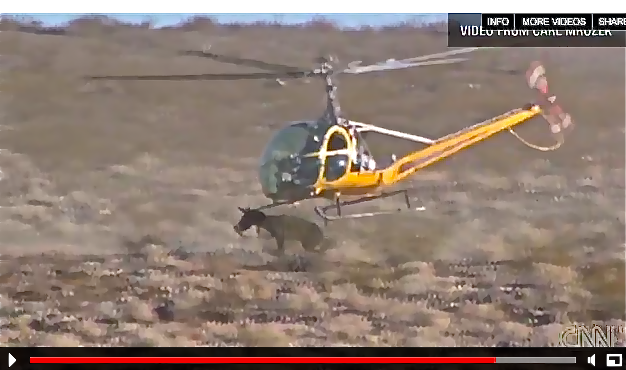

CNN footage by Carl Mrozek

The above are still shots of the CNN footage from January 2, 2011, provided by filmmaker Carl Mrozek. The CNN piece stops with the burro trying to get to his feet.
Carl tells us that this burro went limping, hobbling off when it got up. He or she was obviously injured. What a sad, terrible, avoidable thing. What a commentary on roundups. Yet our BLM director dares to call roundups humane? Why are not these contractors being roundly chastised for these gruesome assaults on innocents? The above looks to me like sheer spite. Burros are very frustrating for the pilots, very challenging.
Carl tells us that this burro went limping, hobbling off when it got up. He or she was obviously injured. What a sad, terrible, avoidable thing. What a commentary on roundups. Yet our BLM director dares to call roundups humane? Why are not these contractors being roundly chastised for these gruesome assaults on innocents? The above looks to me like sheer spite. Burros are very frustrating for the pilots, very challenging.
Is it humane for the helicopter pilot to literally push an old mare, running for all she’s worth, toward the trap just to show off?
BLM footage/Public Domain: Freezeframes by Elyse Gardner


This poor girl was doing everything asked – no, demanded -- of her; there was no excuse for this. Do you know, Mr. Abbey, that this footage is considered standard operating procedure by BLM since it was provided by BLM for a promotional video to Rick Harmon of Cayuse contractors?
Do you consider it humane for an impatient pilot to literally push a frightened yearling who is slowly moving toward the trap?
©9/16/10 Elyse Gardner


These are not "isolated incidents." BLM has never gone on the record opposing these practices; in fact, the promotional video footage of the helicopter pushing, toying with the white mare, above, was filmed by BLM and provided to the pilot, Rick Harmon of Cayuse, Inc., demonstrates that BLM is not disturbed by this. I have yet to hear of BLM disciplining or correcting its contractors' behavior in any manner. The pilots get on top of these animals, pressuring them intensely.
BLM footage/Public Domain: Freezeframes by Elyse Gardner


This poor girl was doing everything asked – no, demanded -- of her; there was no excuse for this. Do you know, Mr. Abbey, that this footage is considered standard operating procedure by BLM since it was provided by BLM for a promotional video to Rick Harmon of Cayuse contractors?
Do you consider it humane for an impatient pilot to literally push a frightened yearling who is slowly moving toward the trap?
©9/16/10 Elyse Gardner

©9/16/10 Elyse Gardner

These are not "isolated incidents." BLM has never gone on the record opposing these practices; in fact, the promotional video footage of the helicopter pushing, toying with the white mare, above, was filmed by BLM and provided to the pilot, Rick Harmon of Cayuse, Inc., demonstrates that BLM is not disturbed by this. I have yet to hear of BLM disciplining or correcting its contractors' behavior in any manner. The pilots get on top of these animals, pressuring them intensely.
Is it humane to allow a helicopter to juggle numerous bands of horses to bring in as many as possible, allowing each band time to double back to try to return to the mountains, and thus causing these animals to run literally triple the distance? I will be releasing a video of this scenario shortly, filmed over the course of 67 minutes that the horses were within view. We can only imagine how much this went on before we could see, since we waited two hours for the helicopter to return with the horses.
Is it humane for wild horses to be run so long and hard that mares heavy with foal abort, and mares who've just given birth are fleeing for their lives? That babies fall behind and get separated from their mothers, sometimes orphaned? I have witnessed and documented many roundups. This happens regularly.
©2010 Roped foal being brought in alone. How terrifying for them to fall behind from their families.
 This foal was obviously exhausted and had had to give up as his family raced off trying to evade the helicopter. When Dave Cattoor and the wrangler roped him an brought him in, he had a rope around his neck, coming back around under his tail into Dave Cattoor's hand, which hand yanked on the rope periodically to keep the foal moving forward by irritating the youngster's anus. The foal was weak, and it appeared to me Mr. Cattoor would not let it rest in fear it would collapse. The worst part of this is the foal having to fall behind and be separated. Safeguards can be in place to prevent this almost entirely. Instead, it happens nearly every day, at least once. I am not alleging that this walk back in was horrible abuse; it was very telling, however, and it should never have happened.
©2010 Roped foal being brought in alone. How terrifying for them to fall behind from their families.

Roundup crews used to proclaim that they let mares with foals drop back if they can't keep up.
1) That is not the common practice that I see in roundups.
2) Mares with foals need to stay with their bands, not be left out alone.
3) If a band has a foal who can't make it, the band should be left alone, or the pace adjusted down to the weakest member's needs.
Is it humane to not even have a distance or speed maximum to which the pilots must adhere? Is it truly humane to depend on the judgment of profit-driven pilots?
1) That is not the common practice that I see in roundups.
2) Mares with foals need to stay with their bands, not be left out alone.
3) If a band has a foal who can't make it, the band should be left alone, or the pace adjusted down to the weakest member's needs.
Is it humane to not even have a distance or speed maximum to which the pilots must adhere? Is it truly humane to depend on the judgment of profit-driven pilots?
Is it humane to call all these things humane?
What I actually think is going on here is this: Bob Abbey is a very busy man. I don’t know if Bob Abbey reads my blog. I doubt it, although I know many BLM officials do. I suspect he relies on others to keep him informed, and someone isn't telling him what is happening. I suspect that he is truly unaware of most if not all of these well documented issues. It stands to reason; would you want your boss to know how inhumane things really were?
One need not be "credentialed" as a vet to document and recognize sweat, limping, suffering. Having four people look at the scenarios above, all of which I’ve documented, and tell me they are “humane treatment” simply tells me about these people, to wit: (A) They don’t know what they’re talking about, or, (B) They lack integrity and cannot be trusted, or (C) They have not seen the material; (D) Contractors were on "best" behavior that I wish they'd stay on.
Try going to a five-week roundup and showing up virtually every day.
Try going to a five-week roundup and showing up virtually every day.
Hi, Tom Gorey. On behalf of BLM, you boast of an illusory 1 percent death rate from the roundups. When? In Calico the death rate was more like 5 to 8 percent. Which leads to the next issue:
A big part of "BLM math" is saying certain deaths are "not gather related." Consider the burro who died on 9/12/10 in the trailer on the way to temporary holding pens. The burros run fast and hard and try with all their little might to avoid the trap. They scatter in different directions when the helicopter pressure gets too great. I'll bet contractors use almost twice the helicopter fuel rounding up these hardy little animals who keep their wits even though they are so frightened.
"Gather Updates" actually said the burro who died in the trailer on the way to temporary holding was not gather related. I brought this to a BLM official who said that was a mistake. I agreed. The "Gather Updates" were changed to reflect one "gather related" death.
Similarly, in the Pryor Mountains a horse colicked, another one "tyed up" (had seizures due to rhabdomyolysis), and a number of foals were seriously lame, but BLM's web site said there were "no injuries." There we have a prime example of what I call "BLM math."
A big part of "BLM math" is saying certain deaths are "not gather related." Consider the burro who died on 9/12/10 in the trailer on the way to temporary holding pens. The burros run fast and hard and try with all their little might to avoid the trap. They scatter in different directions when the helicopter pressure gets too great. I'll bet contractors use almost twice the helicopter fuel rounding up these hardy little animals who keep their wits even though they are so frightened.
"Gather Updates" actually said the burro who died in the trailer on the way to temporary holding was not gather related. I brought this to a BLM official who said that was a mistake. I agreed. The "Gather Updates" were changed to reflect one "gather related" death.
Similarly, in the Pryor Mountains a horse colicked, another one "tyed up" (had seizures due to rhabdomyolysis), and a number of foals were seriously lame, but BLM's web site said there were "no injuries." There we have a prime example of what I call "BLM math."
And since when do we determine whether something is humane based on whether an animal can survive it? I know of many animals who survive terrible beatings: Does that mean the beating was "humane"? Non sequitur: it does not follow.
1) The story of Blue Moon, the stallion:
Since when is it humane to strike a stallion with the blade of the helicopter – and the pilot was so bent on doing this that he nearly failed to pull the helicopter up in time, nearly crashing into the hillside in this poorly laid out trap site;
2) This same stallion was so traumatized when he finally was driven into the trap that he tried crashing through the fence and broke his neck.
Is it humane to allow this proud band leader, this blue roan stallion with an obviously broken neck, to lay paralyzed, in pain, while wranglers nonchalantly continue to load horses 15 feet away from him?
Euthanasia: that was the time. The humane thing to do would have been to give him the relief of a bullet. That is when it’s time to euthanize a horse; not because he came in with a minor issue like a club foot, or born blind in one eye but is otherwise healthy, well muscled, and obviously perfectly well adjusted.
Obviously the contractors knew this was disgustingly wrong since they pulled netting across to block the view of the public observing this hideous roundup by Sun J in Warm Springs. When the camera records this magnificent stallion still laying there feebly attempting to move his legs, the contractors then moved their truck such that it entirely blocked the view of the public, again demonstrating they knew full well this was not humane, not the right thing to do. They were afraid of the cameras, didn’t want the observers to have “the shot.”
And that demonstrates the priorities of Washington all the way down the line: You are more concerned with how things look than you are with the welfare of the horses, in this case that one innocent stallion. That horse suffered a gruesome end, and moreso because he was forced to lay helpless in pain and watch humans load his family and take them away.
Is it humane to force a mare to wait over an hour in a trailer with her dead stallion --well, we don't know if he really was dead by then because he, too, was not examined or euthanized after he broke his neck by crashing into the panel fence, but he lay paralyzed from a broken neck before he expired.
Because of incidents like Blue Moon's, above, we cannot be confident that a horse is dead just because BLM wranglers cover him up.
And that demonstrates the priorities of Washington all the way down the line: You are more concerned with how things look than you are with the welfare of the horses, in this case that one innocent stallion. That horse suffered a gruesome end, and moreso because he was forced to lay helpless in pain and watch humans load his family and take them away.
Is it humane to force a mare to wait over an hour in a trailer with her dead stallion --well, we don't know if he really was dead by then because he, too, was not examined or euthanized after he broke his neck by crashing into the panel fence, but he lay paralyzed from a broken neck before he expired.
Because of incidents like Blue Moon's, above, we cannot be confident that a horse is dead just because BLM wranglers cover him up.
Is it humane to run burros nearly two hours and then leave them for six hours baking in the high desert in the hot sun in a crowded pen?


Some of these amazing little burros endured a tremendous helicopter-assisted roping chase at the end, trying to evade the trap. They would have been panting and tremendously parched.
In the Calico roundup, Hope's story:
Is it humane for a helicopter to stay on a terrified foal by flying only five feet off his tail when that baby is obviously, to anyone watching, already well into the funnel of the trap and is struggling with all his might just to keep up with his family? (Click the link above to see the video.)

©5/16/10 Craig Downer SORRO
 He was the starving foal who apparently was stolen from his real mother by a dry mare at birth and never got to eat. He was noticed within the five days of his life, but no looked closely enough to see what was really going on. It was only when we, the public, were visiting this now-closed-to-the-public facility that he was discovered. The vet deemed it too late, and he was euthanized. Sometimes the care is great. Unfortunately, sometimes horses go unnoticed. The door is now closed to the public.
Courtesy of Palomino Armstrong HONEY BANDIT
 Honey Bandit was another instance of a foal living for at least a week or two as an orphan under the "care" of a BLM holding facility, yet BLM staff failed to observe or aid this baby. No one knows where his mother was. Not only was he starving and lonely, but he was covered with bites received by mares protecting their milk for their own foals, from whom he unsuccessfully tried to nurse. Palomino Armstrong was visiting the facility, overheard a conversation about him, took him home, and fought like a tiger for his life. The only good thing BLM did for this foal was to give him to Palomino.
(For those who want to know about his interesting name: Palomino and her husband were headed for a second honeymoon when this baby came into their lives. Honeymoon got put aside... This little bandit stole their honeymoon, hence the name Honey Bandit.)
Lastly for now, the issue of destroying family bands in the course of a roundup is an inhumane practice on a class level. Even in roundups where BLM intends to trap, treat, and release, no care is taken to respect the hard-won families and social structure of these animals. To minimally manage on the range, as the law provides, would mean to round up a band, keeping it together, treat the mares, and release the band as a unit. Now that we understand what close bonds these animals form, this practice is no longer acceptable.
Is it humane for a helicopter to stay on a terrified foal by flying only five feet off his tail when that baby is obviously, to anyone watching, already well into the funnel of the trap and is struggling with all his might just to keep up with his family? (Click the link above to see the video.)

This demonstrates either a callous disregard for -- or a complete ignorance of – wild horses, neither of which is acceptable in a professional roundup operator paid hundreds of dollars per animal. This foal later died, his hooves having sloughed off from the grueling run, soft baby hooves on hard, rocky ground.
I must not fail to mention the holding facilities drowning in wild horses and the shortage of oversight, especially of the young foals, whose birth, death, and presence are not even documented so we can't even obtain figures. Sorro is but an example of this at the Broken Arrow facility in Fallon, Nevada. Click on the link (his name) to watch the 32 second video. ©5/16/10 Craig Downer SORRO

Courtesy of Palomino Armstrong HONEY BANDIT

Short-term holding lacks the oversight needed for foals. There is an implied warranty of care BLM offers when it removes these horses from the range where they no longer live their natural independent lives. Doesn't it follow that BLM's failure to step up sufficiently to provide even minimal oversight for the manifold babies in the holding facilities is, at least morally if not legally, criminal negligence?
Honey Bandit nearly died, but thanks to Palomino, he has been nursed to health.(For those who want to know about his interesting name: Palomino and her husband were headed for a second honeymoon when this baby came into their lives. Honeymoon got put aside... This little bandit stole their honeymoon, hence the name Honey Bandit.)
Lastly for now, the issue of destroying family bands in the course of a roundup is an inhumane practice on a class level. Even in roundups where BLM intends to trap, treat, and release, no care is taken to respect the hard-won families and social structure of these animals. To minimally manage on the range, as the law provides, would mean to round up a band, keeping it together, treat the mares, and release the band as a unit. Now that we understand what close bonds these animals form, this practice is no longer acceptable.
We are calling for truly humane parameters. We do not agree with BLM math, which I will address below. But for the moment let’s talk roundup.
A roundup, for whatever reason – emergency, PZP, sickness, whatever – should have clear guidelines so we can objectively determine and protect these horses with no ambiguity about what is humane.
A roundup, for whatever reason – emergency, PZP, sickness, whatever – should have clear guidelines so we can objectively determine and protect these horses with no ambiguity about what is humane.
Right now, sole discretion is the pilot’s. Some of these pilots have demonstrated predation and a callous disregard for the safety and welfare of the burros and horses even though the argument is made that it is to their financial best interest to bring in healthy animals. This must not be allowed to continue. But not only is BLM taking no action to correct and prevent future recurrences, but it muddies the water and calls cruelty and abuse “humane,” thereby giving the public less and less reason to trust it with every passing day, every passing roundup.
How can we trust someone who refuses to even acknowledge wrong?
To effect a roundup approaching a truly humane scenario as far as possible when using a helicopter, we are calling for the implementaton of these things to be included in the roundup contract:
1) A mounted video camera on the helicopter (this was also recommended in the report of BLM's handpicked observers, which tells us this is truly a minimal requirement) with a live feed to observers on the ground, including person(s) not just selected by BLM;
2) A daily reporting of the GPS coordinates of each and every trap site along with (A) the time, and (B) the GPS coordinates (place) where each band or single horse, as the case may be, is picked up to begin the drive to the trap pen;
3) A set maximum distance and speed bearing in mind the makeup of the band as far as possible
4) A strictly enforced requirement that the helicopter:
(A) Never touch an animal unless it is to save his/her life;
(B) Maintain a distance no closer than 50 to 100 feet unless it is necessary for the safety of the horses, as in diverting them from a ledge;
5) Water be made available at all trap pens if the animals are in the pens longer than 45 minutes, bearing in mind that these animals have just experienced a sustained exertion exceeding any natural movement they do in the wild;
6) Create a review team, to include members of the public not handpicked by BLM, for the purpose of determining whether injuries are gather related at each day's roundup.
7) Levy financial fines to include possible forfeiture of that animal's payment to contractor for animals determined to have sustained gather related injuries.
8) Allow the interested public true access in witnessing roundups.
9) Allow wild horses to remain free who have monumentally struggled, jumped, or otherwise regained their freedom. These animals are truly wild, retaining attributes we want on the open range. The contracts are set up so the contractors get paid for bringing them in. Please direct them (contractors and BLM staff) to leave them be.
10) Open the doors to Broken Arrow, all short-term facilities, especially so the public can see horses freshly rounded up. Often we don't get to see them at all at the trap sites, and we only sometimes get a cursory look at them in temporary holding if we are lucky. It helped tremendously to be able to go to Broken Arrow during the Twin Peaks roundup (correction: during the Calico roundup, not Twin Peaks. Broken Arrow was closed to the public for the duration of the Twin Peaks roundup-EG) and visit the horses. I strongly request and urge that you reopen Broken Arrow, certainly at least during roundups so the public can actually see the horses BLM is removing.
11) Open the doors to long-term holding by making reasonable accommodation for the public to visit at least occasionally. I need to see for myself where our Calico mares, shaken up in that recent trailering accident, are living.
I want to get this blog posted, so I will stop here. I may have forgotten important things, which I can add later or do another post.
Setting aside the reasons, I acknowledge that there are times wild horses and burros need to be rounded up although I disagree with this as the primary management tool of BLM.
Reasons for roundup aside, on behalf of the wild horses and burros, it is my aim to work with BLM to create a truly humane scenario for this to occur.
This is a new year: I earnestly ask the BLM to please stop offending the public and the animals by declaring the present state of affairs to be "humane" and therefore acceptable. Until BLM is willing to admit and accept that these things need changing, we will continue to distrust it, and it will remain nearly impossible to accomplish real change on behalf of the horses and burros, and the country.
I must now take a few moments to address the numbers and how BLM skews the facts in favor of cattle.
Alan Shepherd makes misleading remarks on TV about, “We can’t cheat everybody else for the horse,” when it’s everybody else who’s cheating the horse out of his fair legal share of the range resources in his legal HMAs, his tiny percent of what’s left of his little pie.
How can we trust someone who refuses to even acknowledge wrong?
To effect a roundup approaching a truly humane scenario as far as possible when using a helicopter, we are calling for the implementaton of these things to be included in the roundup contract:
1) A mounted video camera on the helicopter (this was also recommended in the report of BLM's handpicked observers, which tells us this is truly a minimal requirement) with a live feed to observers on the ground, including person(s) not just selected by BLM;
2) A daily reporting of the GPS coordinates of each and every trap site along with (A) the time, and (B) the GPS coordinates (place) where each band or single horse, as the case may be, is picked up to begin the drive to the trap pen;
3) A set maximum distance and speed bearing in mind the makeup of the band as far as possible
4) A strictly enforced requirement that the helicopter:
(A) Never touch an animal unless it is to save his/her life;
(B) Maintain a distance no closer than 50 to 100 feet unless it is necessary for the safety of the horses, as in diverting them from a ledge;
5) Water be made available at all trap pens if the animals are in the pens longer than 45 minutes, bearing in mind that these animals have just experienced a sustained exertion exceeding any natural movement they do in the wild;
6) Create a review team, to include members of the public not handpicked by BLM, for the purpose of determining whether injuries are gather related at each day's roundup.
7) Levy financial fines to include possible forfeiture of that animal's payment to contractor for animals determined to have sustained gather related injuries.
8) Allow the interested public true access in witnessing roundups.
9) Allow wild horses to remain free who have monumentally struggled, jumped, or otherwise regained their freedom. These animals are truly wild, retaining attributes we want on the open range. The contracts are set up so the contractors get paid for bringing them in. Please direct them (contractors and BLM staff) to leave them be.
10) Open the doors to Broken Arrow, all short-term facilities, especially so the public can see horses freshly rounded up. Often we don't get to see them at all at the trap sites, and we only sometimes get a cursory look at them in temporary holding if we are lucky. It helped tremendously to be able to go to Broken Arrow during the Twin Peaks roundup (correction: during the Calico roundup, not Twin Peaks. Broken Arrow was closed to the public for the duration of the Twin Peaks roundup-EG) and visit the horses. I strongly request and urge that you reopen Broken Arrow, certainly at least during roundups so the public can actually see the horses BLM is removing.
11) Open the doors to long-term holding by making reasonable accommodation for the public to visit at least occasionally. I need to see for myself where our Calico mares, shaken up in that recent trailering accident, are living.
I want to get this blog posted, so I will stop here. I may have forgotten important things, which I can add later or do another post.
Setting aside the reasons, I acknowledge that there are times wild horses and burros need to be rounded up although I disagree with this as the primary management tool of BLM.
Reasons for roundup aside, on behalf of the wild horses and burros, it is my aim to work with BLM to create a truly humane scenario for this to occur.
This is a new year: I earnestly ask the BLM to please stop offending the public and the animals by declaring the present state of affairs to be "humane" and therefore acceptable. Until BLM is willing to admit and accept that these things need changing, we will continue to distrust it, and it will remain nearly impossible to accomplish real change on behalf of the horses and burros, and the country.
I must now take a few moments to address the numbers and how BLM skews the facts in favor of cattle.
Alan Shepherd makes misleading remarks on TV about, “We can’t cheat everybody else for the horse,” when it’s everybody else who’s cheating the horse out of his fair legal share of the range resources in his legal HMAs, his tiny percent of what’s left of his little pie.
Facts: Out of the roughly 240 million acres BLM manages, 160 million acres are managed for livestock grazing.
Originally, the 1971 Wild Free Roaming Horse and Burro Act committed 51.3 million acres to the wild horses and burros. That is down to 26-some million acres now.
Originally, the 1971 Wild Free Roaming Horse and Burro Act committed 51.3 million acres to the wild horses and burros. That is down to 26-some million acres now.
So out of 160 million grazing acres, the horses and burros get only 26 million; cows and sheep are everywhere.
Out of that 26 million, the wild horses and burros only receive 25% of the resources, yielding the predominance of range resources to livestock grazing even in their own Herd Management Areas.
©9/16/10 Elyse Gardner
Out of that 26 million, the wild horses and burros only receive 25% of the resources, yielding the predominance of range resources to livestock grazing even in their own Herd Management Areas.
©9/16/10 Elyse Gardner

"Horses? Well, I saw one about 6 years ago."
Right now I want to acknowledge that every day is a gift, and I am privileged to be starting another year working on behalf of these wonderful animals. Happy new year, everybody.
For the wild horses, captive and free, and their humble, stalwart burro friends,
Elyse Gardner
Humane Advocate Observer


